Small Woodworking Shop Ideas: How to Build in Tight Spaces
Many beginners think they can’t start woodworking because they don’t have a garage or a large workshop. But the truth is, you don’t need a big space to build great projects. Some of the most productive woodworkers work in small, well-organized areas.
A small woodworking shop is an advantage. With fewer distractions and better organization, you can work more efficiently and safely. In this guide, you’ll learn practical small woodworking shop ideas, how to design your setup, and how to make the most of limited space.
Quick Answer
The best small woodworking shop setup uses vertical storage, a compact workbench, multi-purpose tools, and organized layouts. Even a small corner can become a highly functional workspace when designed efficiently.
Why Small Workshops Work Well
Small spaces can be surprisingly productive when planned correctly. The key is understanding that limitations often force better habits and smarter decisions.
Advantages of a small shop:
- Easier to organize — Less space means fewer places for tools to get lost
- Less walking between tools — Everything is within arm’s reach, saving time and energy
- Lower setup cost — Smaller spaces require fewer materials and less expensive infrastructure
- Faster cleanup — A compact area can be cleaned and organized in minutes
- More efficient workflow — Forced proximity creates natural work sequences
- Better focus — Limited space eliminates distractions and keeps you task-oriented
Many professionals intentionally design compact workshops because they increase productivity. When everything has a designated place and tools are always visible, you spend more time building and less time searching.
The psychological benefit is significant as well. A small, well-organized shop feels manageable and inviting, while a large, cluttered space can feel overwhelming and discouraging.
Step 1 — Choose the Right Location
You don’t need a full room to create a functional woodworking space. The right location balances accessibility, ventilation, and noise considerations.
Great small workshop locations:
- Garage corner — Often the most practical choice with good ventilation and floor protection
- Basement wall area — Climate-controlled and private, though ventilation requires attention
- Balcony workspace — Excellent for hand tool work with natural light and ventilation
- Spare room corner — Convenient but requires dust management and noise consideration
- Closet workshop — Surprisingly effective for hand tool enthusiasts who can close the doors when not working
Minimum recommended space: About 4×4 feet (16 square feet)
This minimal footprint is enough for a small workbench, basic tool storage, and room to work on small to medium projects. If you have 6×6 feet or more, you’ll have even greater flexibility.
Location considerations:
- Ventilation — Essential for finishing work and dust management
- Electrical access — At least one dedicated outlet for power tools
- Flooring — Concrete or protected flooring that can handle spills and dropped tools
- Lighting — Natural light is ideal, but good artificial lighting works well
- Noise tolerance — Consider neighbors and family members when choosing a location
Step 2 — Use Vertical Storage
Vertical storage is the secret weapon of small workshops. When floor space is limited, walls become your most valuable real estate.
Best vertical storage ideas:
- Wall-mounted tool racks — Custom racks keep frequently-used tools at eye level
- Pegboards — Infinitely customizable and allow you to see all your tools at once
- Shelf units — Stackable shelving maximizes vertical space for materials and supplies
- Hanging clamp racks — Clamps take up significant space, but hang efficiently on walls
- Magnetic tool strips — Perfect for chisels, screwdrivers, and small metal tools
- French cleat system — Modular wall storage that allows easy reconfiguration
Using wall space frees your work surface and keeps tools visible. The “see it, use it” principle means you’re more likely to use tools that are visible rather than buried in drawers.
Vertical storage tips:
- Mount storage at comfortable heights (between waist and eye level for frequently-used items)
- Use clear containers for small parts so you can see contents without opening
- Install storage on multiple walls to distribute weight and maximize access
- Leave some wall space open for future additions as your tool collection grows
Step 3 — Build or Buy a Compact Workbench
Your workbench is the center of your shop and should be considered carefully. In a small space, the right workbench makes all the difference.
Best small-space workbench features:
- Foldable design — Wall-mounted fold-down benches save space when not in use
- Storage underneath — Drawers or shelves below the work surface maximize utility
- Clamp-friendly edges — Overhang or dog holes allow secure workpiece clamping
- Solid top surface — Stability matters more than size; a sturdy 2×4 foot bench beats a wobbly 4×8 foot table
- Appropriate height — Typically 34-36 inches for general work, adjusted to your height
A small but sturdy bench is better than a large, unstable one. You can always extend your work surface temporarily with sawhorses or a folding table when needed.
Workbench options:
- DIY 2×4 construction — Affordable and customizable to your exact space
- Portable workbench — Commercial options like the Black & Decker Workmate fold for storage
- Wall-mounted fold-down — Ideal for extremely tight spaces, folds flat when not in use
- Modified desk or table — Repurpose existing furniture with added vise or clamping options
Consider adding a woodworking vise or bench dogs to increase your bench’s functionality. Even a small vise dramatically improves your ability to hold workpieces securely.
Step 4 — Choose Multi-Purpose Tools
In small workshops, versatility matters more than specialization. Each tool should earn its place by serving multiple functions.
Best tools for small spaces:
- Cordless drill/driver — Handles drilling and screw driving, eliminating two separate tools
- Hand saw — Compact, quiet, and requires no power or storage for cords
- Circular saw — Makes straight cuts, crosscuts, and rip cuts with one tool
- Clamps — Essential for assembly, gluing, and securing workpieces (you can never have too many)
- Measuring tools — Combination square, tape measure, and marking gauge cover most layout needs
- Random orbital sander — Handles finish sanding on flat and curved surfaces
- Japanese pull saw — Cuts on the pull stroke with excellent control in tight spaces
You can avoid large machines that take up floor space unless necessary. A table saw, for example, requires significant space and can often be replaced by a circular saw with a guide for small shop work.
Tool selection strategy:
- Start with hand tools that require no electricity or storage space
- Add one power tool at a time based on actual project needs
- Choose cordless over corded when possible for flexibility
- Prioritize tools that handle multiple operations
Step 5 — Keep Tools Organized
Organization is more important than the size of the space. A well-organized 4×4-foot shop outperforms a cluttered 10×20-foot garage.
Simple organization system:
- One drawer for measuring tools — Tape measures, squares, marking gauges, pencils
- One bin for fasteners — Screws, nails, and hardware sorted by type and size
- One rack for cutting tools — Saws, chisels, and planes in dedicated spots
- One shelf for finishing supplies — Sandpaper, stains, oils, and brushes together
A place for everything prevents clutter and saves time. When every tool has a home, cleanup takes minutes instead of hours.
Organization principles:
- Group by function — Keep related tools together (all measuring tools, all cutting tools, etc.)
- Store by frequency — Most-used tools at eye level, occasional-use tools higher or lower
- Label everything — Clear labels on bins and drawers eliminate guessing
- Use shadow boards — Outline tools on pegboards so you know exactly where each belongs
- Implement the “one in, one out” rule — When adding a new tool, consider removing one you don’t use
Small Shop Layout Example
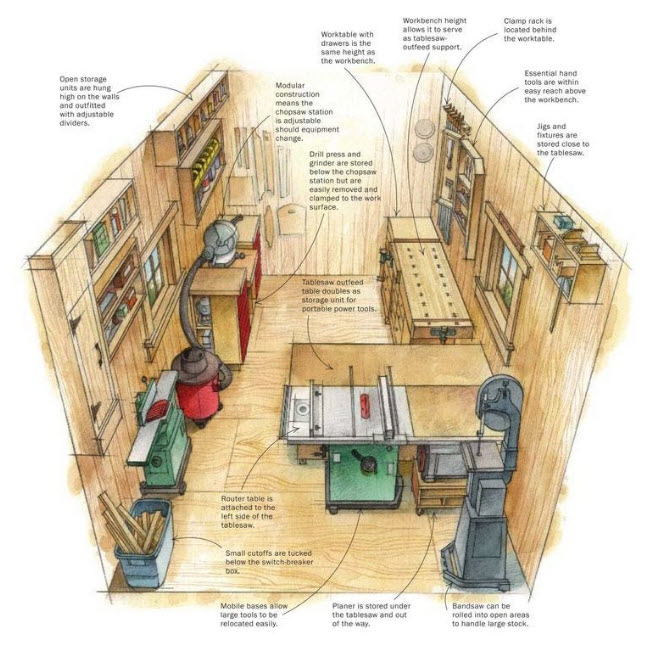
Strategic layout maximizes efficiency in a limited space:
| Area | Purpose |
|---|---|
|
Workbench center
|
Cutting + assembly
|
|
Wall space
|
Tool storage
|
|
Shelf
|
Materials
|
|
Floor corner
|
Power tools
|
This layout keeps everything accessible while maximizing workspace. The workbench is in the center, with tools stored on the walls within easy reach. Materials are stored vertically on shelves, and power tools live in a designated corner when not in use.
Layout principles:
- Work triangle — Position your most-used tools (saw, drill, measuring tools) in a triangle around your workbench
- Clear pathways — Maintain at least 2 feet of clearance for safe movement
- Flexible space — Design for easy reconfiguration as projects and needs change
Mistakes People Make in Small Workshops
Avoid these common errors, and your shop will feel twice as big:
- Storing tools randomly — Without designated homes, tools multiply clutter exponentially
- Using large furniture — Oversized cabinets and tables waste precious floor space
- Keeping unused tools — Tools you haven’t used in a year should be sold or donated
- Ignoring wall space — Failing to use vertical storage is the biggest missed opportunity
- Poor lighting — Inadequate lighting makes spaces feel smaller and less functional
- Buying before planning — Purchasing tools and storage before measuring your space leads to a poor fit
Space problems are usually organizational, not size-related. Most small shop frustrations can be solved with better organization rather than more square footage.
Pro Tips for Small Workshop Efficiency
Follow these practices, and your small shop will feel professional:
- Keep only the tools you use often — Resist the urge to collect tools “just in case.”
- Clean after every session — A 5-minute cleanup prevents overwhelming messes
- Store wood vertically — Lumber racks on walls save floor space and prevent warping
- Label storage bins — Clear labels save time and reduce frustration
- Keep the work surface clear — Your bench should be empty except during active work
- Use mobile bases — Put larger tools on wheels so they can be moved when needed
- Create a project staging area — Designate one spot for current project materials
Efficiency beats size every time. A well-run small shop produces better results than a disorganized large space.
Lighting Tips for Small Workshops
Good lighting improves safety, accuracy, and the overall feel of your workspace.
Best lighting setup:
- Overhead light for general visibility — LED shop lights provide bright, even illumination
- Adjustable desk lamp for detail work — Task lighting for precision work like marking and measuring
- Natural light, if possible — Windows reduce eye strain and improve mood
- Shadow-free positioning — Place lights to eliminate shadows on your work surface
Poor lighting causes more mistakes than a lack of skill. Invest in quality lighting before buying more tools—it’s one of the best upgrades for any small shop.
Lighting recommendations:
- Aim for 75-100 lumens per square foot for general shop lighting
- Use daylight-balanced bulbs (5000-6500K) for accurate color perception
- Install lights on multiple circuits to avoid total darkness if one fails
- Consider battery-powered LED strips for inside cabinets and drawers
Noise Control for Small Spaces
If you work in shared living spaces, noise management makes woodworking possible:
- Use hand tools when possible — Hand saws and planes are nearly silent
- Work during daytime — Respect neighbors and family members with reasonable hours
- Add rubber mats under tools — Vibration dampening reduces noise transmission
- Close doors and windows — Simple barriers significantly reduce sound escape
- Choose quieter tools — Brushless motors and quality tools run more quietly
- Communicate with neighbors — Let them know your schedule and ask about concerns
This makes woodworking possible even in apartments. Many successful woodworkers operate in shared spaces by being considerate and strategic about noise.
Dust Management in Small Spaces
Dust control is critical in compact workshops:
- Shop vacuum with HEPA filter — Captures fine dust that causes health issues
- Dust collection at the source — Attach vacuum hoses directly to power tools
- Air filtration — Ceiling-mounted air cleaners remove airborne particles
- Work outside when possible — Take sanding and cutting outdoors in good weather
- Seal off the space — Plastic sheeting prevents dust from spreading to living areas
Proper dust management protects your health and keeps your workspace functional.
FAQ
How small can a woodworking shop be?
A workspace as small as 4×4 feet can be enough for beginner woodworking. Many successful woodworkers operate in spaces this size by focusing on hand tools and smart organization.
Is a garage required for woodworking?
No. Many beginners work successfully in small indoor spaces, such as spare rooms, basements, or even closets. The key is good ventilation, dust control, and organization.
What’s the most important part of a small shop?
A sturdy workbench and organized storage system. These two elements form the foundation of any functional workshop, regardless of size.
Should beginners buy large machines?
Not usually. Large machines take up space and aren’t necessary for early projects. Start with versatile hand tools and compact power tools, then add larger equipment only when specific projects require it.
How do I deal with limited storage?
Use vertical wall space extensively, store lumber vertically, and keep only the tools you use regularly. Consider off-site storage for seasonal items or rarely-used equipment.
Final Verdict
A small woodworking shop can be just as effective as a large one if it’s organized properly. With smart storage, a compact workbench, and versatile tools, you can build an efficient workspace almost anywhere.
The size of your workshop doesn’t determine your results—your organization and skills do. Many master craftspeople have produced exceptional work in spaces smaller than a typical bedroom. What matters is thoughtful design, consistent organization, and focusing on skills rather than square footage.
Start with the space you have, implement these small woodworking shop ideas, and you’ll discover that limitations often lead to creativity and efficiency. Your small shop can become a productive, enjoyable workspace that serves you well for years to come.
What To Read Next
To continue improving your setup and skills:
- Beginner woodworking tools list — Essential tools to start your collection
- Cheapest way to start woodworking — Budget-friendly approaches for new woodworkers
- Easy projects for beginners — Simple builds to practice skills in your new space
- Hand tools vs power tools — Choosing the right tools for small spaces
Each guide helps you build smarter and work more efficiently in your compact workshop.